In short
- Your brand is everything a customer feels about you, not just the logo and the ads.
- The more often and consistently you show up online and offline, the easier it is for people to recognise you and the fewer campaigns you need.
- Your domain, hosting and social media profiles must belong entirely to you, not to the agency that works for you.
- Your website has to be clear to Google and to voice assistants alike if it is going to bring you real customers.
Why do some new products become recognisable and others don’t?
Having a good product is not enough. Many small business owners in Bulgaria learn this the hard way: they have made quality goods, filled the warehouse and are keen to sell, but the market does not respond. The problem is not the product. It is that nobody remembers it. A brand is not just the logo on the packaging. It is everything the customer experiences: a slow website, a crushed box, an email that never got a reply. If these things are off, the product stays just a product. When we get them right and keep everything consistent, recognition starts to build. That is when sales arrive that don’t depend on constant ad spend.
What is a brand, really, and why is it more than a logo?
A brand lives in the customer’s head, not on a business card. It is the sum of every encounter with the business: how fast the website loads, how the employee answers, what happens when a delivery is late. The same shop can look cheap and unreliable or professional and solid without changing a thing about its goods. The difference is consistency. When the message is the same everywhere, online and in person, people remember you naturally.
A brand is not what a business says about itself. A brand is what the customer remembers after the purchase is over.
Why does brand building matter for small and mid-size businesses in Bulgaria?
For a small business, trust matters more than the ad budget. Big chains can afford expensive campaigns and treat early losses as normal. In Bulgaria, though, small and mid-size companies survive when customers remember them and come back. More and more people here check online what to buy, including through AI assistants. If your brand doesn’t appear in those answers, as far as the customer is concerned it doesn’t exist.
A strong brand reduces the need for paid ads. When people search for your business by name, every further marketing investment brings more profit. According to Gartner, trust in big brands fell from 70% in 2021 to 60% in 2025. That is a chance for smaller players: trust no longer comes automatically with size, it is earned through consistency.
Step 1: Define your identity: name, slogan, tone of voice and visual identity
Before we start on the website or the packaging, the basics need to be clear. The brand name should be easy to pronounce in Bulgarian, distinct from foreign words and available as a domain. The slogan is not decoration but a short promise of what the customer gets. The way the brand communicates sets how it sounds everywhere: in emails, on social media, on the packaging. The visual language (colours, fonts, photos) has to stay the same from the business card to the website. Without this foundation, every next step costs more and takes longer.
- Name: short, easy to say and remember, with the domain available
- Slogan: one sentence with a concrete benefit for the customer
- Tone of voice: formal or friendly, expert or approachable
- Visual identity: colours, typography, image style
How to choose a name and slogan people remember?
A good name sticks the first time you hear it. It should be short, have no double meaning and not sound like a foreign word with an unpleasant sense. Before you settle on it, check that the .bg domain is free and that no other company in the same field uses the same name. A slogan only works when it promises a concrete benefit. “Always the best” says nothing. “Delivery within 24 hours” says it all.
Tone of voice: how does your brand talk to its audience?
Tone of voice is the brand’s character, expressed in words. The same product can sound like a strict expert or like a friend explaining things in plain language. The choice depends on the audience: mothers of young children expect warmth and understanding, construction developers expect precision and figures. Once you choose a style, use it everywhere: in product descriptions, in replies to enquiries, in social media posts. Customers recognise the brand’s voice before they have even read its name.
Step 2: Build a website that Google and AI assistants understand
The website is central to any brand. It is not only a place to sell, but also where you build trust, share useful information and hold attention. Customers judge a business in the first few seconds, and a slow site or one that looks bad on a phone drives them away. To work, the site has to be clear not only to people but also to Google and AI assistants. A good structure answers users’ questions and points them to the next step. SEO gives you visibility in Google search. AEO and GEO make sure you also appear in the answers of ChatGPT and similar assistants. All three matter for a strong brand in 2026.
A site Google doesn’t understand brings no enquiries. A site AI assistants don’t understand will soon have no visitors either.
Step 3: The technical foundation: domain, hosting and accounts
This step gets skipped until it is too late. Your domain is a brand asset. If it is registered in the name of an agency or a freelancer, the business does not own it. The same goes for hosting, social media profiles and email accounts. Changing suppliers should not mean losing access to years of content and recognition.
- Register the domain in the business owner’s name
- Keep hosting under the business’s control, with the option to switch provider
- Keep access to Facebook, Instagram, Google Business Profile and email in the owner’s hands
- Document passwords and access from day one
Step 4: Integrate Bulgarian couriers and local services
Delivery is part of the experience. If an order is late with no explanation, the customer remembers the delay, not the beautiful website. Integrating with Bulgarian courier companies automates the process: it generates waybills, tracks parcels and sends the customer notifications. Completing a purchase has to be as easy as possible, because the fewer steps between ordering and receiving, the more likely the customer is to come back. Local services such as automatic invoicing, cash on delivery and courier integration make things easier for Bulgarian shoppers and show that the business is well organised.
Step 5: Offline presence: trade fairs and physical shops
Taking part in trade fairs and having a physical shop can strengthen the brand’s image and the trust people place in it. A trade fair brings many potential customers and partners together in one place, which gives you direct contact. A physical location shows that the business is stable and serious. The interplay between online and offline channels is key: the website supports negotiations with retailers, and the shop drives searches online. A Harvard analysis of brand as a competitive advantage shows that digital channels are used more and more both to look for information and to actually buy, but that does not make physical presence any less important. Treat the two kinds of channel as complementary, not as competitors.
Example: how did Donkydoo build its brand from scratch?
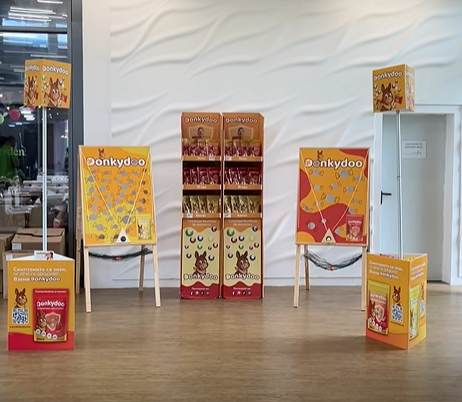
Donkydoo is a good example of a successful product brand launch. The first steps were the identity, the website, the online shop, the content and the trade fair materials, all developed in parallel. Results came quickly because from the very start every part of the brand spoke in the same tone.
- Just a few months after launch, the products are sold in physical shops in more than 10 towns
- The online shop gets regular orders from organic traffic, with no need for paid advertising
- An interactive game for children was added to the website, which makes the brand interesting to its audience itself
- A stand at one of the biggest children’s trade fairs in Bulgaria, already in the first months
This shows that recognition doesn’t take years. What matters is consistency.
How is AI changing the rules of brand building?
AI assistants are no longer the future. ChatGPT, Google AI Mode, Perplexity and Claude are becoming a main channel through which people discover products and services. If your site is not structured so that artificial intelligence can read it, your brand simply won’t appear in the results. This is a new front for visibility, alongside classic SEO. Academic research confirms the direction: automated analysis of web content already extracts brand identity and image from online sources effectively, as a review of research on AI and branding in Humanities and Social Sciences Communications shows. A brand that is not optimised for machines stays invisible to a growing share of the market.
“Automated web content mining effectively extracts destination brand identity and image from online sources,” the authors of the bibliometric review conclude.
Comparing brand building approaches: online vs offline vs integrated
| Approach | Speed of reaching a wide audience | Startup costs | Building trust | Direct contact with the customer | Long-term sustainability | Suits this type of product |
|---|---|---|---|---|---|---|
| Online focus | Fast: you reach customers within weeks | Low: no need for physical locations | Gradual: through reviews and content | Limited: mostly through comments and emails | Depends on keeping up your digital presence | Products that don’t need to be seen in person before purchase |
| Offline focus | Slow: depends on geography and partnerships | High: rent, stands, printed materials | Fast: through personal contact in shops and at fairs | Strong: the customer can touch and try the product | Depends on established trade relationships | Products that need to be seen or tried before purchase |
| Integrated approach | Best: online channels give reach, physical locations give depth of contact | Highest: two channels to maintain | Fastest: the customer sees the brand everywhere | Combined: both online and in person | Highest: doesn’t depend on a single channel | Products sold both online and in physical shops |
An online focus is practical for digital services and niche products. An offline focus suits local businesses with limited reach. Combining online and offline channels is the best option for products sold both online and in person.
Common brand building mistakes and how to avoid them
One of the most common mistakes is reducing the brand to a logo. A beautiful mark gets made, but nobody has thought through the positioning, the tone of voice or the target customer. A logo on its own cannot make up for a product that isn’t aimed at a specific audience. Another frequent problem is inconsistency: if the website, the business cards and the staff send different messages, customers sense straight away that there is no single identity. Putting off SEO and AI integration is also a common mistake, because by the time you get to it, competitors will have taken the top spots. Neglecting ownership of the domain and accounts is another serious gap, and so is impatience: expecting results in two weeks and giving up in the third.
Pros and cons of planned brand building
Pros: more recognition, higher profits, less dependence on advertising, loyal customers, easier entry into retail chains.
Cons: it takes time and consistency, results don’t come instantly, mistakes can be costly, and it needs constant upkeep and development.
How to keep your brand consistent online and offline?
Brand consistency is not a given. It is built through clear rules and steady practice. Brand guidelines are the key tool for this: a single document that brings together the whole visual identity (logo, colours, fonts), defines the tone of voice and gives examples of correct and incorrect use. Everyone who works with the brand’s content and materials should follow these guidelines.
- Create brand guidelines: visual identity, tone of voice, core messages.
- Use the same logo, colours and fonts across all channels, from the website to the trade fair stand.
- Regularly audit every touchpoint: website, social media, packaging, emails.
- Train the team and partners to use the brand elements correctly.
- Update the guidelines when the product range changes or you enter new markets.
How to measure brand building success?
Sales are an important result, but not the only measure of success. Brand popularity is measured by how often people search for it online, by direct traffic to the website and by how often it is mentioned on social media. Trust shows in customer reviews and referrals, and in the number of repeat purchases. Visibility is tracked through Google rankings and mentions by voice assistants. When we measure these indicators, we can tell whether the brand is really growing or just surviving.
Frequently asked questions
How long does it take to build a recognisable brand?
It depends on how actively you work on your brand and how consistent you are. For example, for a client who publishes one new article a week and takes part in trade fairs regularly, the first signs of greater recognition usually appear within five to six months. Building a strong brand in full, though, often takes a year or more, especially if you are new to the market.
What’s the difference between brand identity and brand image?
Identity is what the business creates and presents: name, visuals, messages. Image is how customers perceive the brand. The two rarely match completely. In our work we have seen a more conservative identity, for example, lead to a more modern image because of customers’ activity on social media. The job of brand management is to bring the two closer through consistency and active feedback.
Can a small business build a brand without a big ad budget?
Yes, absolutely. Recognition is not something you only buy with advertising. It is built through quality content, good service and an active presence wherever your audience is. For example, a client who runs a blog with useful articles and replies quickly on social media often gets more organic traffic and referrals than a paid campaign would bring.
How do AI assistants like ChatGPT affect your brand?
They change how people find information: instead of browsing several sites, users get one summarised answer. If your site’s content is not optimised for AI to read, you risk going unnoticed. Preparing for AI search is becoming as important as classic SEO.
What matters more for a new brand: online or offline presence?
It depends on the product. For digital services, online presence comes first. For goods sold in physical shops, you also need offline contact. The most effective option is to combine the two channels: for example, the website supports conversations with retailers, and the shops send customers to the brand online.
How do I protect my brand name and logo in Bulgaria?
The safest way is to register a trademark with the Bulgarian Patent Office. The procedure includes a search for existing similar marks and filing an application. It is best to do this before you invest heavily in advertising and packaging, so you avoid disputes later.
At WebTact we cover the whole process, from building your brand identity and creating websites optimised for AI to courier integration and preparing for trade fairs. For a specific project and a scope estimate, you can request a consultation on the service page.